From Tired to Alert: How Does Caffeine Work?

Researcher: Dishita Ghai
Research Editor: Sahij Sidhu
We are all familiar with caffeine. With exam season approaching and assignments piling up, it’s common to rely on a cup of coffee or an energy drink to stay awake and focused. But what exactly happens in the body when we consume it?
What is Caffeine?
Caffeine is a naturally occurring substance and the world’s most popular stimulant (Shadaia, 2020; Reddy et al., 2024). It is found in coffee, tea, energy drinks, soft drinks, and plants such as guarana berries, cola nuts, and cacao beans (Shadaia, 2020; Rodak et al., 2021).
How Does Caffeine Keep Us Awake?
Absorption
Once it is consumed, caffeine begins working relatively quickly. It is rapidly absorbed from the stomach and small intestine into the bloodstream (Reddy et al., 2024). How quickly it is absorbed can vary depending on the source of caffeine and whether it is consumed with food (Reddy et al., 2024).
Caffeine is typically absorbed within 45 minutes, with peak effects occurring between 30 minutes to one hour (Rodak et al., 2021; Reddy et al., 2024). After entering the bloodstream, it travels throughout the body. Importantly, caffeine can easily cross the blood-brain barrier and enter the brain, where it reaches the central nervous system (Shadaia, 2020).

Figure 1. Adenosine Receptor Blockade. Caffeine molecules, which are similar in structure to adenosine molecules, bind to adenosine receptors and block adenosine’s activity, keeping you awake. Image from BBC Teach (n.d.). Adenosine Receptor Blockade
Caffeine primarily works by blocking adenosine receptors located on the surface of brain cells, or neurons (Rodak et al., 2021; Zheng et al., 2023). Adenosine is a molecule naturally produced in the body that slows down brain activity when it binds to these receptors and reduces the release of various neurotransmitters (McLellan et al., 2016). This process promotes feelings of sleepiness (Reddy et al., 2024).
Since caffeine has a chemical structure similar to adenosine, it can bind to the same receptors (Rodak et al., 2021). By doing this, caffeine blocks adenosine from attaching to these receptors and slowing down brain activity (Zheng et al., 2023). As a result, neurons remain more active, which increases focus and alertness, washing away any sleepiness.
Caffeine also signals the pituitary gland to release adrenaline and norepinephrine. These neurotransmitters are involved in the fight-or-flight response and further increase alertness, keeping the body more awake (Brain et al., 2023a; Zheng et al., 2023). It also helps keep levels of dopamine high (Brain et al., 2023b). Dopamine is a neurotransmitter involved in mood, motivation, and reward-related functions (Zheng et al., 2023). Caffeine does this by slowing its reabsorption and increasing the number of dopamine receptors (Brain et al., 2023b; Zheng et al., 2023).
Metabolism
After a few hours, caffeine unbinds from its receptors and is then metabolized in the liver (Shadaia, 2020). There, it is broken down into other molecules, which are eventually filtered by the kidneys and excreted in urine (Zheng et al., 2023).
Caffeine has an average half-life of about 4–5 hours, meaning it takes that long for half of the caffeine in the body to be eliminated (Shadaia, 2020). But this can vary between individuals due to different factors.
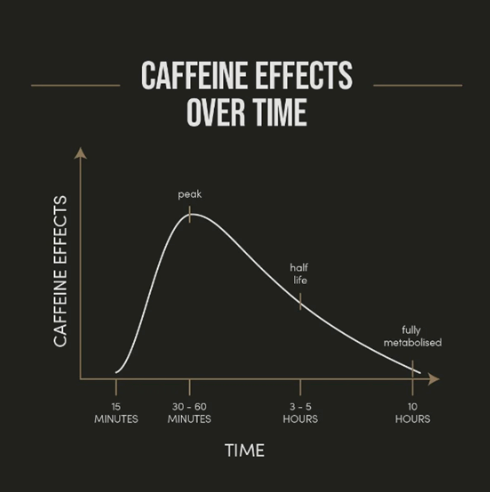
Figure 2. Caffeine Effects Over Time. Caffeine is absorbed quickly, and peak effects occur between 30 minutes to an hour of consumption. In 4-5 hours, half of the caffeine consumed is metabolized and eliminated from the body. Image from Oakley (2025).
Why does this matter?
While caffeine has plenty of benefits, such as increased alertness, enhanced memory, and improved reaction time and attention (McLellan et al., 2016; Shadaia, 2020), there are also some side effects, especially if taken in higher amounts. These include sleep disruption and insomnia, increased heart rate and blood pressure, caffeine intoxication, irritability, anxiety, caffeine dependence, and withdrawal headaches (Zheng et al., 2023; Reddy et al., 2024).
Many students rely on caffeine to cope with busy schedules and lack of sleep. While caffeine can be helpful, it should be used intentionally. Keeping intake below 400 mg per day can help reduce negative effects (Reddy et al., 2023). It is also important to keep in mind that everyone may respond to caffeine differently (Rodak et al., 2021).
Prioritizing sleep, staying hydrated, and maintaining balanced nutrition are other ways to support energy levels (Zheng et al., 2023). By understanding how caffeine works, students can use it more effectively and avoid habits that may negatively impact their well-being.
References
BBC Teach. (n.d.). Does caffeine really make me more alert?. BBC. https://www.bbc.co.uk/teach/articles/zkd4f4j
Brain, M., Bryant, C. W., & Cunningham, M. (2023a, August 18). How caffeine works - Caffeine and adenosine. HowStuffWorks . https://science.howstuffworks.com/caffeine4.htm
Brain, M., Bryant, C. W., & Cunningham, M. (2023b, August 18). How caffeine works - Caffeine and dopamine. HowStuffWorks. https://science.howstuffworks.com/caffeine5.htm
McLellan, T. M., Caldwell, J. A., & Lieberman, H. R. (2016). A review of caffeine’s effects on cognitive, physical and occupational performance. Neuroscience & Biobehavioral Reviews, 71, 294–312. https://doi.org/10.1016/j.neubiorev.2016.09.001
Oakley, H. (2025, July 17). The science behind caffeine. Coffee House. https://www.coffeehouseonline.co.uk/brewandbrowse/science-behind-coffee?srsltid=AfmBOopSO5DxNrkvlKfw6TkzWgEfe_-e_j64qV4nyIUsC9NxqytcmlyI
Reddy, V. S., Shiva, S., Manikantan, S., & Ramakrishna, S. (2024). Pharmacology of caffeine and its effects on the human body. European Journal of Medicinal Chemistry Reports, 10, 100138. https://doi.org/10.1016/j.ejmcr.2024.100138
Rodak, K., Kokot, I., & Kratz, E. M. (2021). Caffeine as a factor influencing the functioning of the human body—friend or Foe? Nutrients, 13(9), 3088. https://doi.org/10.3390/nu13093088
Shadaia, C. (2020). Caffeine’s physiological and psychological effects. [Honours Thesis, Wayne State University]. Digital Commons @ Wayne State. https://digitalcommons.wayne.edu/honorstheses/69
Zheng, S. (2023). Mechanism of caffeine and challenges of caffeine dependence. Highlights in Science, Engineering and Technology, 80, 71–76. https://doi.org/10.54097/3hngc983